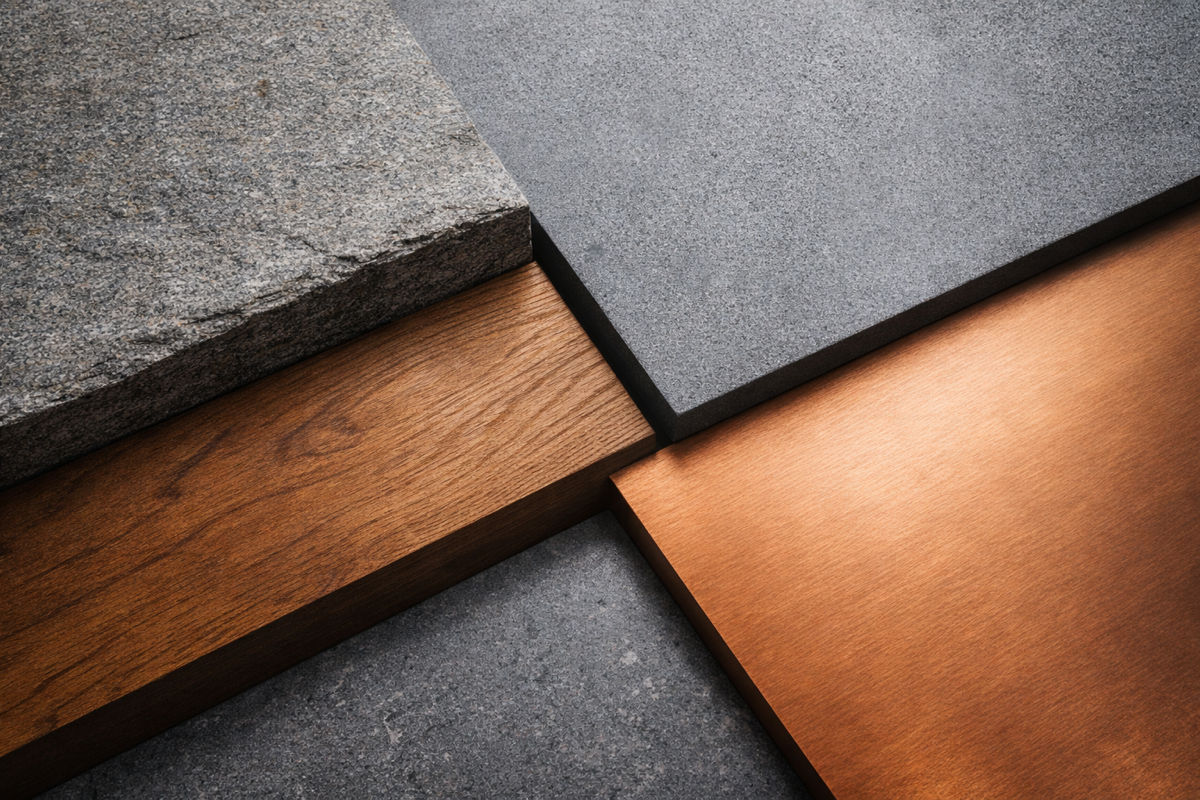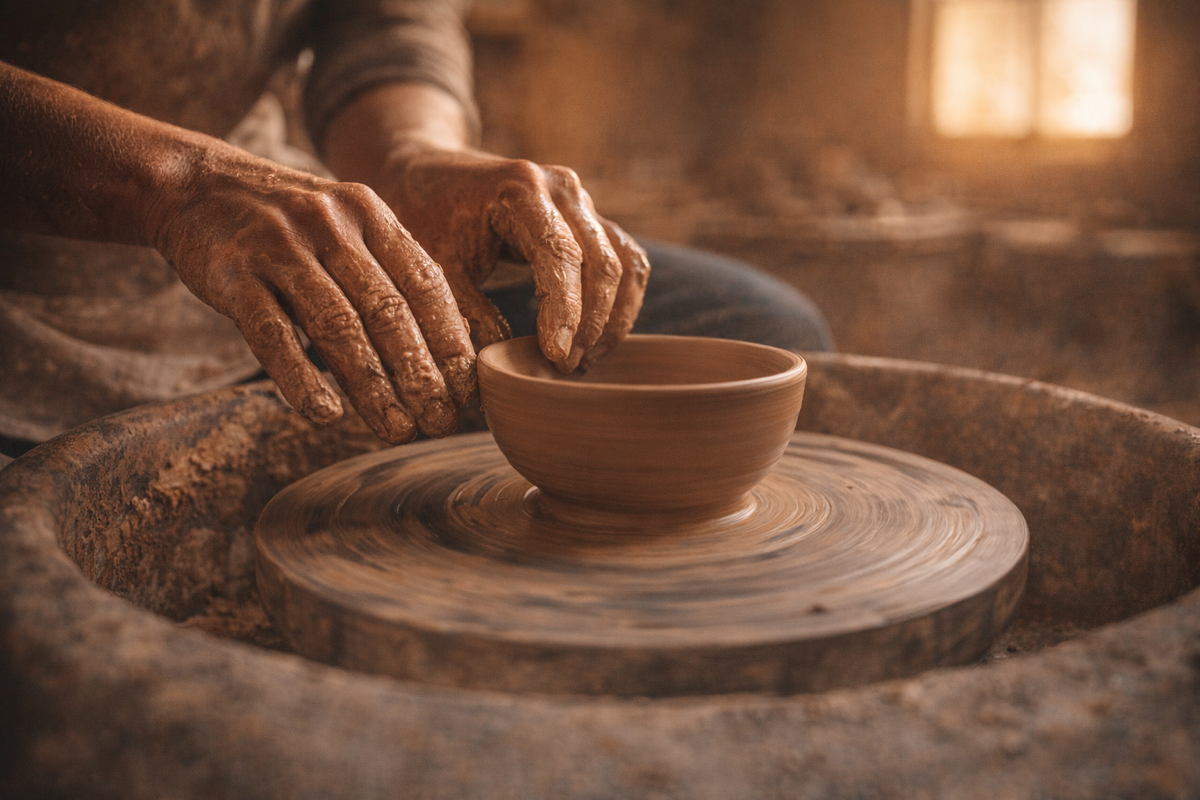
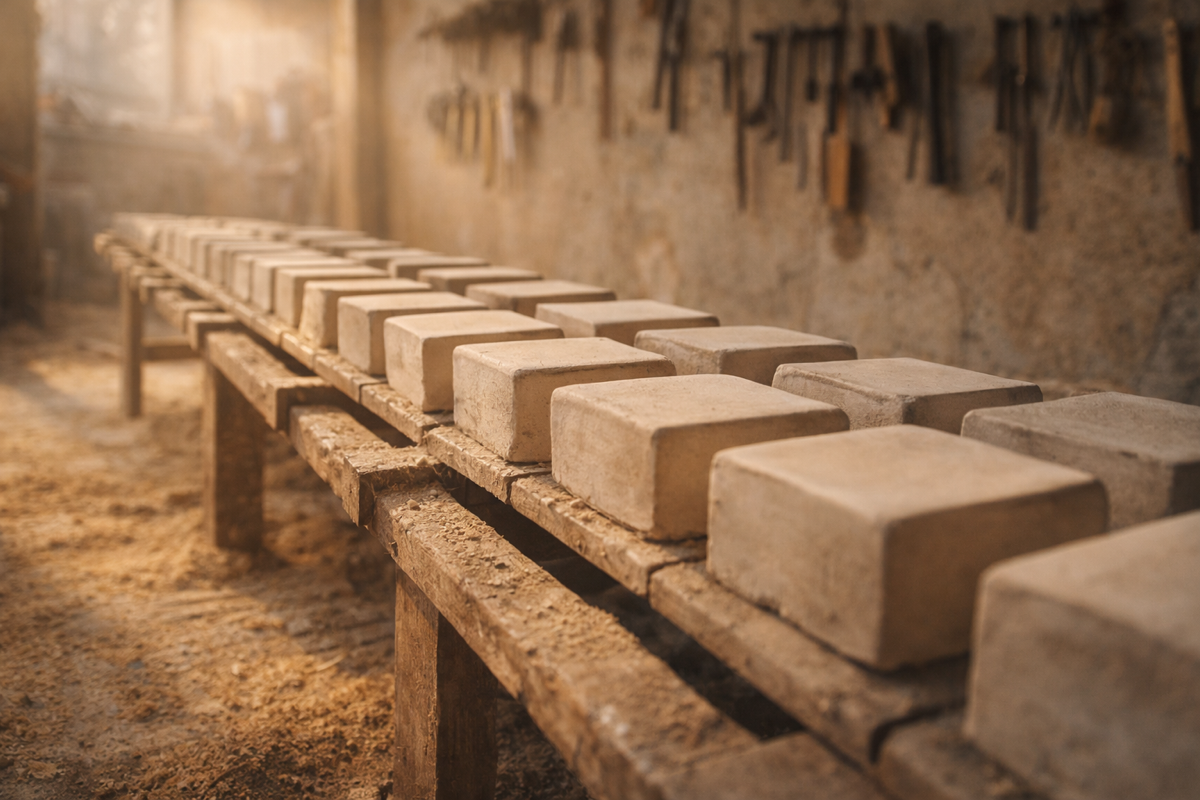
After twenty years of building — houses, studios, renovations, extensions — I have come to believe that the most important decisions happen before the first wall goes up. They happen in the material yard, in the quarry visit, in the conversation with the timber merchant about which boards came from which part of the tree. Materials are not interchangeable. They are characters in a story, and choosing the wrong ones ruins the narrative.
This is not something you learn in architectural school, where materials exist as abstractions — neat swatches and specification sheets. You learn it on site, when the stone arrives and its colour is nothing like the sample, or when the timber warps because it was stored incorrectly, or when the ceramic tiles crack because the substrate was not prepared with sufficient care.
Working with Ceramics
Ceramic tile work is perhaps the most unforgiving of the building crafts. The material is rigid, brittle, and permanent. Mistakes cannot be sanded away or filled over. A poorly laid tile floor will announce its failures for decades — lippage at joints, grout lines that wander, cuts that do not quite meet the wall.
Yet well-executed ceramic work achieves a beauty that no other material can match. The depth of a hand-glazed tile — light entering the surface, reflecting off multiple layers, creating colours that shift with the angle of viewing — is genuinely unique. Factory tiles can approximate this effect but never replicate it. The irregularity of hand-applied glaze creates visual richness that uniform surfaces cannot.
The craft knowledge required is substantial. Understanding substrate preparation, adhesive selection, expansion joint placement, waterproofing integration — these are technical skills that take years to develop. But beyond the technical lies the aesthetic: knowing how to set out a pattern so that cuts fall in unobtrusive locations, how to match grain direction in natural stone tiles, how to create visual rhythm across large surfaces.
The Honesty of Wood
Wood is the most forgiving and the most demanding material simultaneously. Forgiving because mistakes can often be corrected — planed, sanded, filled, refinished. Demanding because it never stops moving. Timber is a living material in the sense that it continues to respond to its environment long after the tree has been felled. It swells with moisture, shrinks in dry conditions, and warps when these forces act unevenly.
A good carpenter understands this movement and designs for it. Joints allow for expansion. Fixings accommodate shrinkage. Boards are oriented so that inevitable cupping is minimised. This is knowledge that cannot be reduced to a specification — it requires understanding the material at a level that only years of handling can provide.
Stone and Its Demands
Stone work is slow work. There is no rushing a dry-stone wall or a precisely fitted limestone floor. The material demands patience and respect — you cannot force stone into configurations it does not want to occupy. Each piece has a natural orientation, a face that wants to be visible, a bed that wants to sit level. The mason's skill lies in reading these preferences and working with them rather than against them.
The weight of stone also imposes practical constraints that lighter materials avoid. Structural support must be adequate. Transport and handling require planning and equipment. Installation sequences must be carefully considered — you cannot easily reposition a 200-kilogram slab once it is in place.
Integration and Craft
The finest buildings integrate these materials in ways that feel inevitable. Stone transitions to timber at exactly the right point. Ceramic surfaces meet wooden frames with precision that reveals the care taken in setting-out. These junctions — where one material meets another — are where craft is most visible and most tested. They are the moments that separate careful building from careless assembly, and they reward the patience and skill that natural materials demand.